


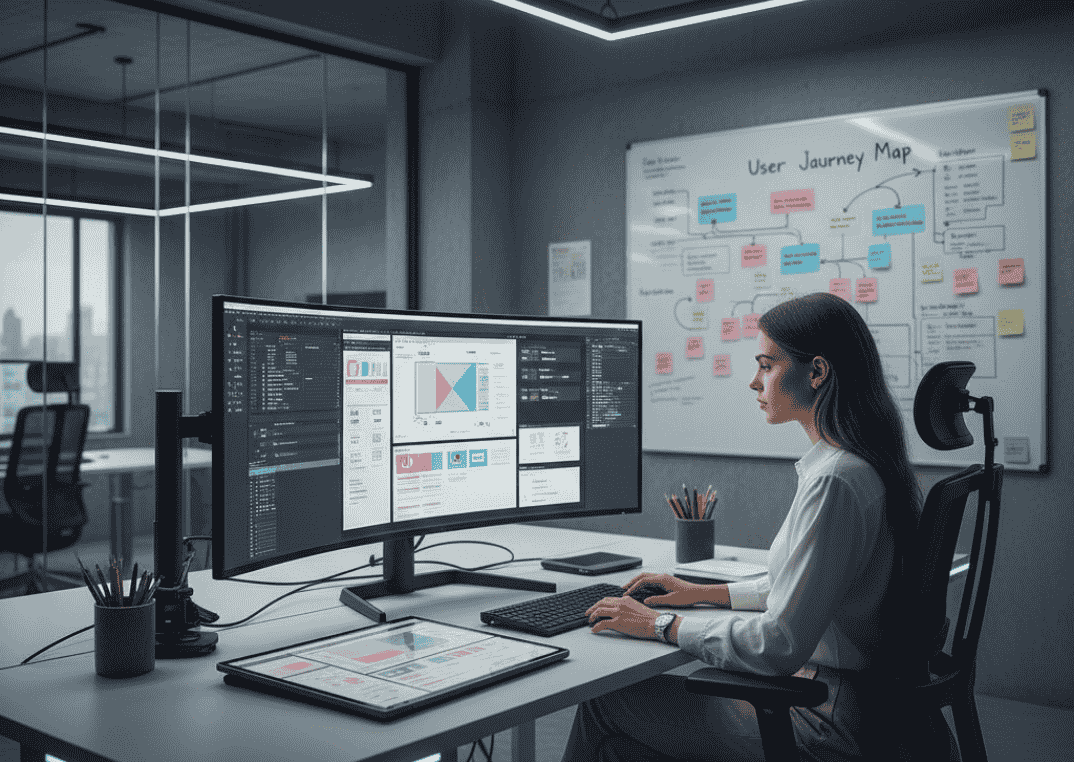
User interface and user experience design extend far beyond visual attractiveness. They influence how customers interact with digital platforms, how easily they complete actions, and how confidently they trust a brand. Poorly designed interfaces create confusion, increase bounce rates, and reduce conversion potential. Businesses must understand that design is directly linked with operational performance. A clear structure, logical navigation, and intuitive flow significantly enhance user engagement.
User journey mapping is essential during design planning. Understanding how customers navigate through a website or application allows businesses to eliminate friction points. Thoughtful placement of call-to-action elements, simplified checkout flows, and structured content hierarchy improve usability. These small improvements collectively increase overall efficiency.
Consistency across devices is another critical factor. With mobile usage continuing to rise, responsive design ensures seamless interaction across screen sizes. Businesses that neglect mobile optimisation risk losing significant engagement opportunities.
Conversion-focused design integrates behavioural psychology principles. Visual cues, contrast usage, whitespace distribution, and trust indicators influence decision-making. Structured design reduces hesitation and builds credibility.
“In many projects, I have observed that businesses underestimate the power of structured UI/UX planning. When design decisions are aligned with user behaviour and business objectives, the improvement in engagement and conversion is clearly visible. Design is not decoration; it is strategic communication.”
— Rupesh Kanade
Performance and design are interconnected. Heavy visual elements that are not optimised can slow down platforms. Efficient UI design balances aesthetics with performance considerations to maintain speed and reliability.
Testing and iteration are essential components of UI/UX maturity. Regular usability testing identifies friction points that internal teams may overlook. Continuous refinement ensures platforms evolve alongside user expectations.
Ultimately, UI/UX design influences trust, usability, and growth potential. Businesses that invest in strategic design planning rather than superficial styling build digital experiences that convert visitors into long-term customers. Structured design is a business investment, not an optional enhancement.